gtag('config', 'AW-654510316');
 1. Introduction
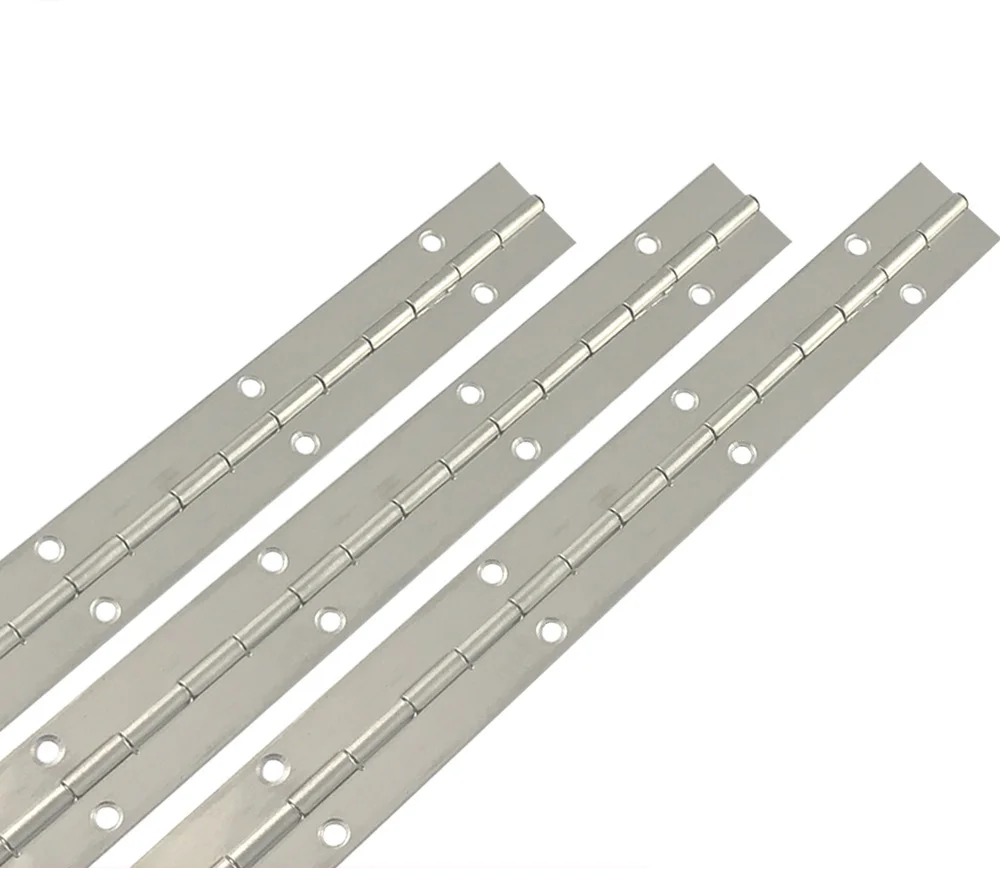
Piano hinges—also known as continuous hinges—are one of the most widely used hinge types in industrial, architectural, and commercial applications. Their defining feature is a continuous leaf and pin structure that runs the full length of a door or panel, providing uniform load distribution and long-term durability.
While the basic concept is simple, piano hinges are far from standardized. In practice, they are engineered in many variations to meet different requirements such as load capacity, corrosion resistance, installation constraints, and functional behavior.
This article provides a systematic and technical classification of piano hinge types, focusing on how they differ in structure, material, and performance—helping B2B buyers, engineers, and distributors make informed sourcing decisions.
2.How Piano Hinges Are Classified
Unlike standard hinges, piano hinges are not defined by a single specification. Instead, they are typically classified across five engineering dimensions:
• Material composition
• Structural design (geometry and leaf configuration)
• Load capacity (thickness and pin diameter)
• Functional mechanism (movement behavior)
• Manufacturing and customization features
Understanding these dimensions is essential because two hinges that look similar can perform very differently in real applications.
3.Types of Piano Hinges by Material
Material is one of the most critical differentiators, directly affecting corrosion resistance, strength, and lifespan.
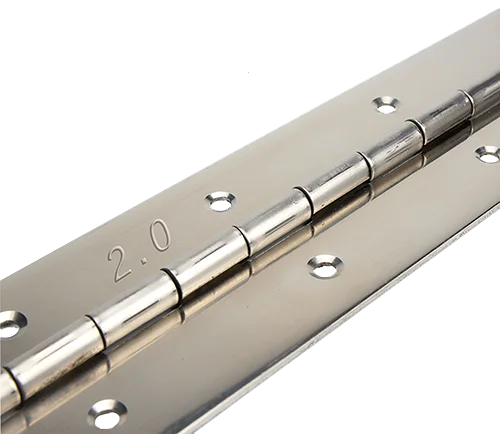
3.1 Stainless Steel Piano Hinges
Stainless steel piano hinges are the most widely specified type for industrial and export markets due to their corrosion resistance and mechanical strength.
Common Grades:
• 201 Stainless Steel
Lower cost, suitable for indoor dry environments
• 304 Stainless Steel
Industry standard, good balance of corrosion resistance and cost
• 316 Stainless Steel
Marine-grade, superior resistance to saltwater and chemicals
Technical Considerations:
• Corrosion resistance comes from chromium oxide layer formation • Surface finish affects performance: • Brushed → better scratch resistance • Polished → better aesthetics but shows wear
Typical Applications:
• Outdoor cabinets • Marine equipment • Food processing machinery
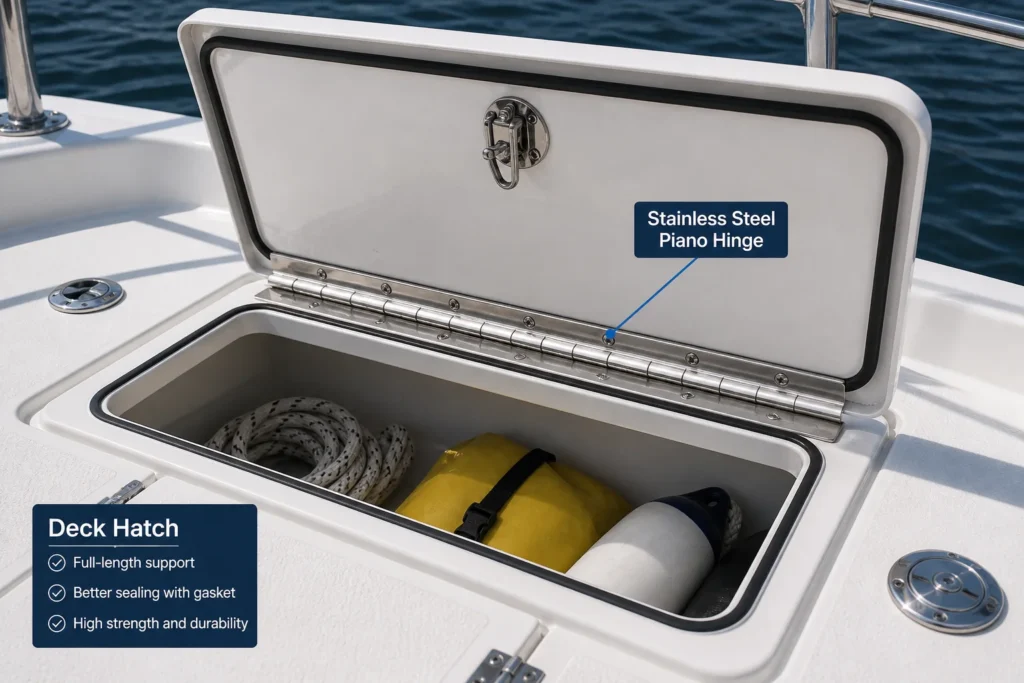
3.2 Steel Piano Hinges
Carbon steel hinges are preferred when high strength and cost efficiency are required.
Surface Treatment Options:
• Zinc plating (standard anti-rust)
• Black oxide (basic protection)
• Powder coating (enhanced durability)
Key Insight:
The coating thickness and quality significantly impact corrosion resistance. Poor plating is one of the most common failure points in low-cost hinges.
Applications:
• Industrial enclosures • Toolboxes • Machinery doors
3.3 Aluminum Piano Hinges
Aluminum hinges are designed for applications where weight reduction is critical.
Common Alloys:
• 5052 → better corrosion resistance • 6061 → higher strength
Characteristics:
• Lightweight but lower load capacity • Easy to cut and machine • Naturally corrosion resistant
Applications:
• Electronic housings • Lightweight panels • Aerospace or transport equipment
3.4 Brass Piano Hinges
Brass hinges are typically used where appearance and corrosion resistance are both important.
Two Brass Types of Piano Hinges:
• Solid brass • Brass-plated steel
Considerations:
• Solid brass offers better durability but higher cost • Brass can tarnish over time without coating
Applications:
• Furniture • Decorative boxes • Premium cabinetry
4.Types of Piano Hinges by Structural Design
Structural design determines how the hinge interacts with the door and frame. This is one of the most important—but often overlooked—classifications.
4.1 Standard Piano Hinges
The most common configuration with equal leaf width on both sides.
Characteristics:
• Straightforward installation
• Balanced load distribution
• Cost-efficient production

4.2 Wide Leaf (Wide Throw) Piano Hinges
These hinges have extended leaf width to increase mounting surface and load distribution.
Technical Advantage:
A wider leaf increases the moment arm, reducing stress concentration on fasteners.
Applications:
• Thick doors • Industrial panels • Offset mounting scenarios
4.3 Narrow Piano Hinges
Designed for limited installation space.
Limitations:
• Reduced load capacity • Smaller fastening area
Applications:
• Small enclosures • Compact equipment
4.4 Offset Piano Hinges
Offset hinges are engineered so that the pivot point is not centered, allowing the door to clear obstructions.
Engineering Purpose:
• Moves pivot axis outward • Prevents interference with frame or wall
Applications:
• Flush-mounted doors • Cabinets with thick frames
4.5 Concealed Piano Hinges
Installed inside the door and frame, making them invisible when closed.
Requirements:
• Precision machining • Tight tolerance control
Applications:
• High-end furniture • Architectural doors
4.6 Slip-Joint (Loose Pin) Piano Hinges
Feature a removable pin for easy disassembly.
Advantages:
• Simplifies maintenance • Allows quick panel removal
Applications:
• Equipment access panels • Service doors
5.Types of Piano Hinges by Load Capacity
Load capacity is not a fixed category but is determined by physical dimensions and material strength.
Key Parameters:
• Leaf thickness • Pin diameter • Leaf width • Material type
Typical Classification:
| Category | Thickness | Pin Diameter | Application |
| Light Duty | <1.0 mm | 2–3 mm | Boxes, covers |
| Medium Duty | 1.0–2.0 mm | 3–5 mm | Cabinets |
| Heavy Duty | >2.0 mm | 5–8 mm+ | Industrial doors |
Important Insight:
In high-cycle applications, pin wear resistance becomes more critical than leaf thickness alone.
5.Frequently Asked Questions
1.what material is best for outdoor piano hinges
Best material for outdoor piano hinges: 316 stainless steel (coastal/marine); 304 stainless steel for regular outdoor use.
2.What is the difference between stainless steel and aluminum piano hinges?
Stainless steel is stronger and more corrosion-resistant, while aluminum is lighter and easier to cut but less durable.
3.Where are piano hinges commonly used?
They are used in doors, electrical cabinets, toolboxes, machine covers, folding tables, and marine hatches.
6.Conclusion
Piano hinges may appear simple, but their variations in material, structure, and mechanical function create a wide range of specialized types. For industrial and commercial applications, selecting the correct type requires a detailed understanding of these classifications rather than relying on general specifications.
For B2B buyers, the key is to evaluate piano hinges not just by price, but by engineering parameters, application suitability, and customization capability. A well-selected hinge improves product performance, reduces maintenance, and enhances overall system reliability.