 gtag('config', 'AW-654510316');
 What is the difference between long piano hinges and normal hinges?
The main difference between a long piano hinge (also called a continuous hinge) and a normal hinge (typically a butt hinge) is their Structure & Appearance, load distribution, and applications.
1. Structure & Appearance
Long Piano Hinge (Continuous Hinge)
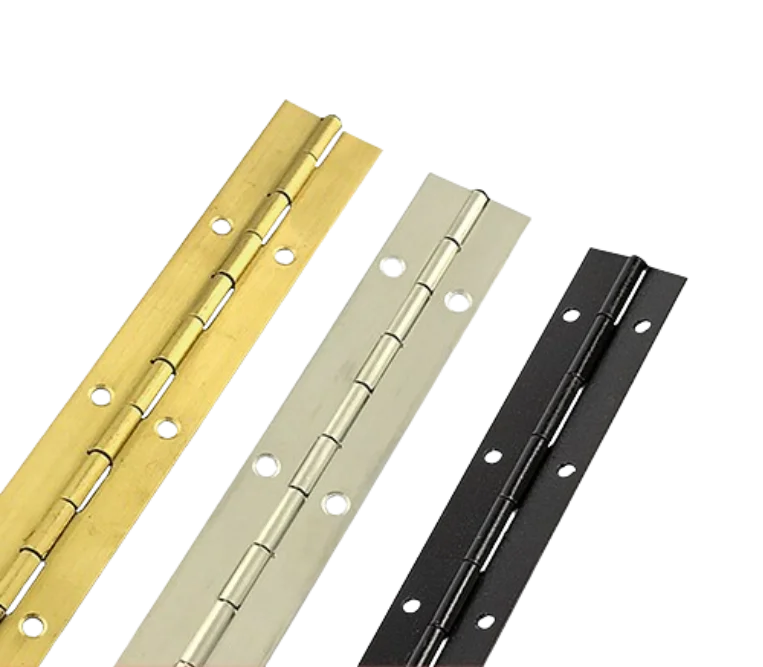
- A single long, full-length strip hinge running the entire edge of a door, lid, cabinet or piano lid.
- Consists of two long metal leaves connected by a continuous row of tiny knuckles along the whole length.
- Comes in customizable lengths (from short 10cm strips to 2m+ full-length sheets).
Normal Hinge (Butt Hinge, Standard Door Hinge)
- Short, separate individual hinges, only installed at 2–3 discrete points (top, middle, bottom) on a door frame.
- Short knuckle section, only small leaf plates at two ends. Fixed standard sizes (2”, 3”, 4”, 5”).
2. Load & Force Distribution
- Piano hinge: Weight/stress spreads evenly across the full edge. No concentrated stress points; resists sagging even on long, wide lids.
- Normal hinge: All load concentrates on 2–3 small mounting points. Wide/heavy panels easily sag over time.
3. Swing & Movement Performance
- Piano hinge: Smooth uniform rotation along the whole edge; consistent gap when opening, tight flush closure.
- Normal hinge: Rotation only centered on individual hinge pins; uneven gap possible on wide panels.
4. Mounting Application Scenarios
Piano Hinge Best For
- Thin wide lids: Piano lids, wooden storage chests, toolboxes, display cabinets, acrylic display cases, countertop flip panels, aluminum cabinet doors.
- Small lightweight doors that need full-edge support.
Normal Hinge Best For
- Standard room doors, wooden cabinet doors, wardrobe doors, entry doors.
- Narrow doors with moderate weight that only need support at a few points.
5. Installation & Mounting
- Piano hinge: Screws spaced evenly along the entire length; requires precise edge alignment of two panels. Can be surface-mounted or recessed.
- Normal hinge: Only 4–6 screws per single hinge; simple spot mounting at intervals.
6. Durability & Service Life
- Piano hinge: More long-lasting for frequent opening of wide panels; less wear from even force distribution.
- Normal hinge: Prone to loosening screws and sagging on wide heavy panels after repeated use.
| Feature | Piano Hinge (Continuous Hinge) | Normal Hinge (Butt Hinge) |
| Length | Runs almost the entire length of the door or panel | Short individual hinges, usually installed in pairs or threes |
| Load Distribution | Evenly distributes weight along the full edge | Supports weight only at specific mounting points |
| Strength | Higher overall support and durability | Suitable for light to medium-duty applications |
| Installation | Requires more screws and precise alignment | Faster and easier to install |
| Appearance | Continuous, clean line along the edge | Hinges are visible only at mounting locations |
| Typical Applications | Cabinets, industrial enclosures, toolboxes, access panels, folding tables, pianos | Residential doors, furniture, cabinets, gates |
Conclusion
- Piano hinge: Continuous support, higher strength, better weight distribution, ideal for industrial equipment and long panels.
- Normal hinge: Individual hinge points, lower cost, easier installation, ideal for standard doors and cabinets.
Looking for piano hinge ?
Click below to browse E-STAR ‘s Piano Hinge!
